
Course Overview & Resumes
GT 1000 · Lecture 1
Andrew J. Steinmetz
2026-08-28
Your instructor & Team Leader
Dr. Andrew J. Steinmetz
School of Physics · Georgia Institute of Technology
| ajsteinmetz@gatech.edu | |
| Office hours | By appointment (link) |
| Office | Howey W204 |
Elouan Crews
Your Team Leader
| ecrews8@gatech.edu |
Welcome to GT 1000
This seminar is here to help you make a successful transition to college by getting you better acquainted with the academic and social environments at Georgia Tech and explore what it actually means to be a physicist.
This is a discussion-based course. Come ready to participate and to work in small groups.
Course websites:
Syllabus - learning outcomes
By the end of this course, you will be able to:
- Develop self-awareness and self-knowledge, particularly as it relates to your academic interests and professional goals.
- Describe your path to graduation and identify opportunities for academic and professional enrichment with the assistance of a faculty member or advisor.
- Demonstrate the ability to lead and productively participate in collaborative projects.
- Be aware of what it means to be a physicist and explore opportunities for physicists at the undergraduate, graduate, and career levels.
Syllabus - how you are graded
| Course Component | Due | Weight |
|---|---|---|
| Participation, short assignments, and attendance | Weekly | 25% |
| Team Project | TBD | 25% |
| Academic Planning | Multiple deliverables | 25% |
| Career Readiness | Multiple deliverables | 25% |
Note
All four components are weighted equally and there are no exams in this course. The first Career Readiness deliverable is your resume, due September 11.
Course policies - the short version
- Attendance is mandatory. Excessive lateness and absences (three or more per semester) can negatively impact your final grade. Excused absences go through the Dean of Students.
- No textbook. Materials are provided through Canvas/course website.
- No exams.
- The use of generative AI is strongly discouraged. Brainstorming with it is fine, but per the Honor Code no work produced via AI may be submitted as your own.
- Late work is not accepted. All assignments are open the entire semester, so plan ahead.
- When in doubt, ask. Email or office hours.
Part I: What do I do with my degree?
You picked this major a few weeks ago. Here is where it goes.
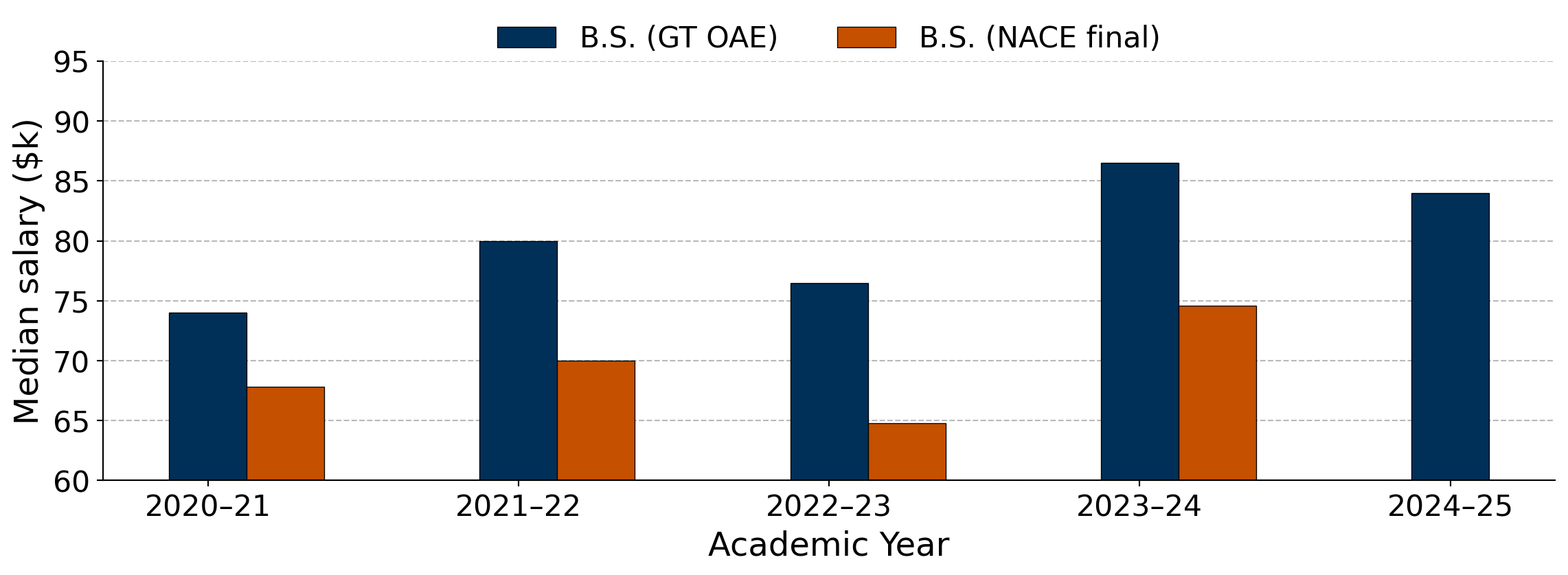
GaTech B.S. Physics: starting salaries
Reported initial median salaries range from $74,000 to $86,500 and are competitive or in excess of national trends reported by NACE.
Part II: September career fair events
Career Center events (https://calendar.gatech.edu/):
- Sept. 8: GT Career Center: In-Person Resume Reviews
- Sept. 9: GT Career Center: Virtual Resume Reviews
- Sept. 10: GT Career Center: Virtual Resume Reviews
- Sept. 14: Fall 2026 All Majors Career Fair
- Sept. 15: Fall 2026 All Majors Career Fair
The career fair is seventeen days away
The Fall 2026 All Majors Career Fair is September 14–15 at Georgia Tech.
Your resume is due September 11 before the fair begins.
Today’s goal: covering what goes on a resume and how to start writing one if you haven’t done so already.
Part III: Resumes
A resume is typically organized into six sections:
- Contact information
- Education
- Experience
- Skills
- Projects and leadership
- Awards and honors (optional)
Not every resume looks the same. The order and emphasis depend on your background and the opportunity.
Resume vs. academic CV
| Resume | |
|---|---|
| Length | 1–2 pages |
| Purpose | Fit for a specific role |
| Used for | Jobs, internships, most undergrad opportunities |
| Customization | Tailored to each application |
For all of you right now, a resume is your concern. For more detail, see the course guide: Resume vs. Academic CV
Contact information
Make this easy to find — usually at the top of the page.
- Full name (prominent — consider a slightly larger font)
- Professional email address (GT email is fine)
- Phone number
- LinkedIn, GitHub or portfolio URL (Optional; if you have one worth sharing)
- City and state — no full street address needed
Education
- Georgia Institute of Technology
- B.S. Physics / Astrophysics / Applied Physics (or joint degree)
- Expected graduation: May 2030 (or your actual date)
- GPA: you do not have a GT GPA yet — leave it off until you have a semester on the books, then include it if it is ≥ 3.0
- Relevant coursework (optional, and useful right now while experience is thin). Academic honors: high school honors and scholarships are fair game this year.
- List your most recent institution first. Your high school can stay on the resume for now, and comes off once you have Tech coursework and experience to replace it.
Experience
The most important section for most employers. Include: work, research, internships, co-ops, teaching assistantships. For each entry:
- Organization name and your role or title
- Dates — month and year (e.g., May 2025 – Aug. 2025)
- Location (city, state) — or “Remote”
- 2–4 bullet points describing what you did and what it produced
Research experience counts strongly for physics students: faculty advisors, national labs, REUs. In the meantime, high school jobs, volunteering, and club roles all belong here.
See https://experiential.learning.gatech.edu/urop/pura-salary/
Writing strong bullets
The most common mistake: describing duties instead of accomplishments.
| Weak | Strong |
|---|---|
| Helped with research in the lab | Analyzed detector calibration data in Python; results incorporated into weekly group reports |
| Responsible for data analysis | Developed signal-processing pipeline in MATLAB, reducing analysis time by 40% |
| Worked on simulations | Implemented Monte Carlo simulation of particle trajectories in C++; validated against published results |
Lead with a strong action verb. Quantify where you can.
Skills
List technical skills — the specific tools and languages you actually know.
Programming and Software Python, MATLAB, C/C++, Julia, Mathematica, LaTeX, Git, Linux/bash, etc.
Laboratory and Instrumentation List specific instruments, techniques, or equipment relevant to your work
Other Data analysis, scientific writing, numerical methods
Do not list generic software (Word, PowerPoint) unless the role specifically requires it.
Projects and leadership
Valuable if work or research experience is limited — which describes essentially all of you today.
Technical projects Computational or experimental class projects with real results. Independent projects, open-source contributions
Leadership and service Club officers, SPS (Society of Physics Students), outreach programs. Teaching or peer tutoring roles
Formatting
Keep it clean and professional.
- One page for most undergraduates
- Consistent fonts — one or two at most; no smaller than 10 pt for body text
- Adequate white space — do not cram everything in
- Consistent alignment of dates and section headers
- No photos, no graphics, no colored text
- Typos and grammar errors are disqualifying. Proofread.
Upcoming schedule
- Start your resume draft — or revisit the one you have.
- Bring it to class next Friday (September 4) — we will workshop drafts in class.
- Resume is due: September 11 at 11:59 PM ET — submitted as PDF to Canvas. Worth 100 points (10% of your final grade) under Career Readiness.
- Career Fair: September 14–15 — Attending counts toward your participation and short-assignment credit.
Part IV: Campus Scavenger Hunt
The fastest way to learn this campus is to walk it.
- Form a group of 2–3 students. Find your group before you leave today.
- Visit all eight locations on the next slide.
- Take a group selfie at each one. Everyone in the group has to be in every photo.
- Assemble the photos into one PDF and submit it to Canvas. The Canvas link goes up shortly — check the course website in the meantime.
Due: September 4 at 11:59 PM ET — worth 40 points (4% of your final grade) under Academic Planning.
The eight locations
- Tech Tower
- Einstein Statue
- Kessler Campanile - “the Shaft” the John Lewis Center
- Ramblin’ Wreck - at the GT Convention Center
- Campus Recreation Center
- Flowers Invention Studio
- Howey Physics Building - my office, W-204
- Clough Commons rooftop
References
Georgia Institute of Technology Office of Academic Effectiveness. 2021-2025. Career and Salary Survey. Georgia Institute of Technology. https://www.oae.gatech.edu/.
Mulvey, Patrick, and Jack Pold. 2025. Physics Bachelors Initial Employment: Academic Years 2020–21 and 2021–22. American Institute of Physics Statistical Research Center. https://doi.org/10.1063/sr.aa204240a3.
National Association of Colleges and Employers. 2021-2026. Salary Survey: Winter Report. National Association of Colleges and Employers. https://www.naceweb.org/research/.
National Association of Colleges and Employers. 2022-2025. Salary Survey: Summer Report. National Association of Colleges and Employers. https://www.naceweb.org/research/.
GT 1000 · Fall 2026 · Section D03 · Georgia Institute of Technology