Good Practice in Science
GT 1000 · Lecture 13
2026-11-20
Upcoming
| What | When | Points |
|---|---|---|
| No class (Thanksgiving) | Nov. 27 | — |
| Course wrap-up and in-class reflection | Dec. 4 | — |
Today Elouan showed what goes wrong in science. These slides are the other side: habits that keep you out of trouble.
Good statistics: Millikan’s oil drop
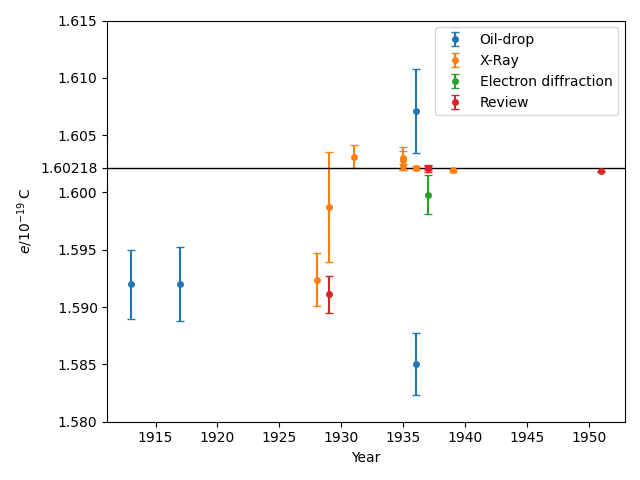
- 1913: Millikan reports \(e = (1.592 \pm 0.003) \times 10^{-19}\) C.
- Today: \(e = 1.602 \times 10^{-19}\) C, more than three of his error bars away.
- The cause was a systematic error: a wrong value for the viscosity of air.
- His uncertainty counted the scatter in his drops, not the error in his inputs.
An error bar is a promise. Make it honest, and include what you don’t control.
Figure: (SciPython 2021), CC BY-SA 4.0. Data: (Millikan 1913; Feynman 1974)
Trust the data wherever it leads
- After 1913, people who measured a value far from Millikan’s hunted for mistakes. People who got a value close to it stopped looking. The accepted value crept up over twenty years.
- Done right: in 2011, OPERA saw neutrinos arrive 60 ns faster than light. They published every check and asked others to find the error: a loose fiber-optic connector.
- Blind analysis: at the LHC, teams build and freeze their analysis on simulation and control data. Only then do they “unblind” the real signal, with no fiddling after.
“You must not fool yourself — and you are the easiest person to fool.” — Richard Feynman
Check the results you like as hard as the results you don’t.
Cite widely and don’t plagiarize
- Credit ideas, data, figures, code, and words, not just direct quotes.
- Paraphrasing still needs a citation.
- Using AI tools? Follow each course’s policy and say how you used them.
- Citing generously costs you nothing. It shows you know the field and lets readers check you.
- Keep sources as you go: a reference manager such as Zotero, plus BibTeX in LaTeX.
Plagiarism at Georgia Tech: submitting work “wholly or substantially identical” to someone else’s without credit. It is an Honor Code violation.
When in doubt, cite it. Then ask your instructor.
Every slide today has a source line. That is the habit.
Put your name on work you are proud of
- Your name on a paper, lab report, or homework says: I did this, I checked it, and I can defend every part of it.
- APS: every author should be able to state and vouch for their contribution and agree to the submission. No gift or ghost authors.
- Elouan’s Schön case: co-authors had their names on fabricated papers. That case and one other led APS to expand its ethics guidelines in 2002, including what co-authors owe.
- Same standard now: your Team Project slides, lab reports, and problem sets.
If you would not want your name on it, it is not done yet.
Source: (American Physical Society, n.d.; Dawson 2003)
References
GT 1000 · Fall 2026 · Section D03 · Georgia Institute of Technology