Graduate School Application Materials
PHYS 4604 · Lecture 9
2026-10-23
Upcoming
| What | When | Points |
|---|---|---|
| NSF GRFP deadline – Physics & Astronomy | Oct. 23 (today), 8:00 PM ET | – |
| Graduate application workshop: bring a statement draft | Oct. 30, in class | – |
| Astrophysics/Astro Graduate Q&A (Room CCB 103) | Nov. 12, 3:30–4:30 PM ET | – |
| Personal statement or cover letter | Nov. 20, 11:59 PM ET | 15% |
| Georgia Tech Physics PhD and BS/MS deadline | Dec. 15 | – |
The goal of today’s lecture: leave with a plan for every piece of your application, and an outline of your statement of purpose to bring to next week’s workshop.
What a committee reads for
A faculty committee is asking one question: will this person succeed as a graduate student and a scientist, here?
Research potential
- Statement of purpose
- Letters from research mentors
Preparation
- Transcript and CV
- Skills in your statement
Fit
- The “why this program” paragraph
- Faculty you contacted
Every piece should point the same way. Your statement makes the claims; your CV and letters back them up.
Statement of purpose vs. personal statement
Statement of purpose
Also called an academic statement.
- Your preparation and research experience
- Your research interests and goals
- Why this program and these faculty
Personal statement
Also called a personal history statement.
- How your background led you to graduate school
- Challenges, service, mentoring, leadership
- Should not repeat the statement of purpose
Some programs ask for both, some for one combined statement. Read each prompt and answer that prompt. Assignment 4 accepts either; write the one your target program asks for.
A structure that fits in 1–2 pages
| Section | What it does | Space |
|---|---|---|
| Opening | Your research interest and goal | 1 paragraph |
| Research experience | The question, your role, the result, what you learned | The most: half a page or more |
| Preparation | Courses, skills, and tools that support it | 1 paragraph |
| Why this program | Faculty, groups, and facilities by name | 1 paragraph, rewritten per program |
| Goals | Where you are headed after the degree | 2–3 sentences |
Typical length is 1–2 pages, or 500–1,000 words. Defer to each program’s requirements.
Open with your research, not your childhood
Before
Ever since I was a child looking up at the night sky, I have been fascinated by the mysteries of the universe.
After
I want to know how dark matter is distributed in dwarf galaxies. For two years I have fit archival rotation curves in Prof. X’s group at Georgia Tech; at [Univ.] I want to test those fits against new radio data.
By the end of your first paragraph, a reader should know your field and what you want to do.
Writing about a research experience
For each project, give:
- The question in one sentence
- Your role: what you did, not what the group did
- The method: instruments, code, analysis
- The result: numbers, a talk, a poster, a paper
- What’s next: what you learned and want to do with it
Before
I worked in a condensed matter lab, where I learned a lot about the research process.
After
In Prof. Y’s lab, I built a four-probe setup and measured the resistivity of 14 thin films from 4 to 300 K. I presented the results at the Spring 2026 Undergraduate Research Symposium.
The fit paragraph
- Name 2–3 faculty and the specific recent work that connects to yours
- Say what you would bring to their group and what you would work on
- Mention groups, centers, or facilities you would use
- Mention any contact you’ve had: an email reply, a visit, a conversation at a conference
Write one strong core statement. Rewrite the fit paragraph for every program, and check that you upload the right version to each school.
Addressing a weak spot
A bad semester, a low grade in a core course, a gap in your record.
Do
- Say it once, briefly and plainly
- Show the recovery with evidence
- Put it in the personal statement or an “additional information” box if the program has one
Don’t
- Open your statement with it
- Apologize repeatedly or make excuses
- Explain more than the reader needs
My Fall 2024 grades reflect a semester I worked 30 hours a week. Since then my physics GPA is 3.7, including A’s in Quantum Mechanics I and II.
Sentence-level style
| Instead of | Write |
|---|---|
| I have always been passionate about physics. | (Cut it. Show it through what you did.) |
| I was exposed to research in a world-renowned lab. | I wrote the analysis code for the group’s 2026 cryostat run. |
| I possess strong analytical skills. | I derived and coded the fit model for … |
| Your prestigious program would allow me to… | Prof. Z’s work on … is the next step from my project on … |
| Measurements were taken. | I measured … |
- First person, active voice. Numbers and names beat adjectives.
- Show qualities, don’t claim them.
Example 1: an admitted statement, annotated
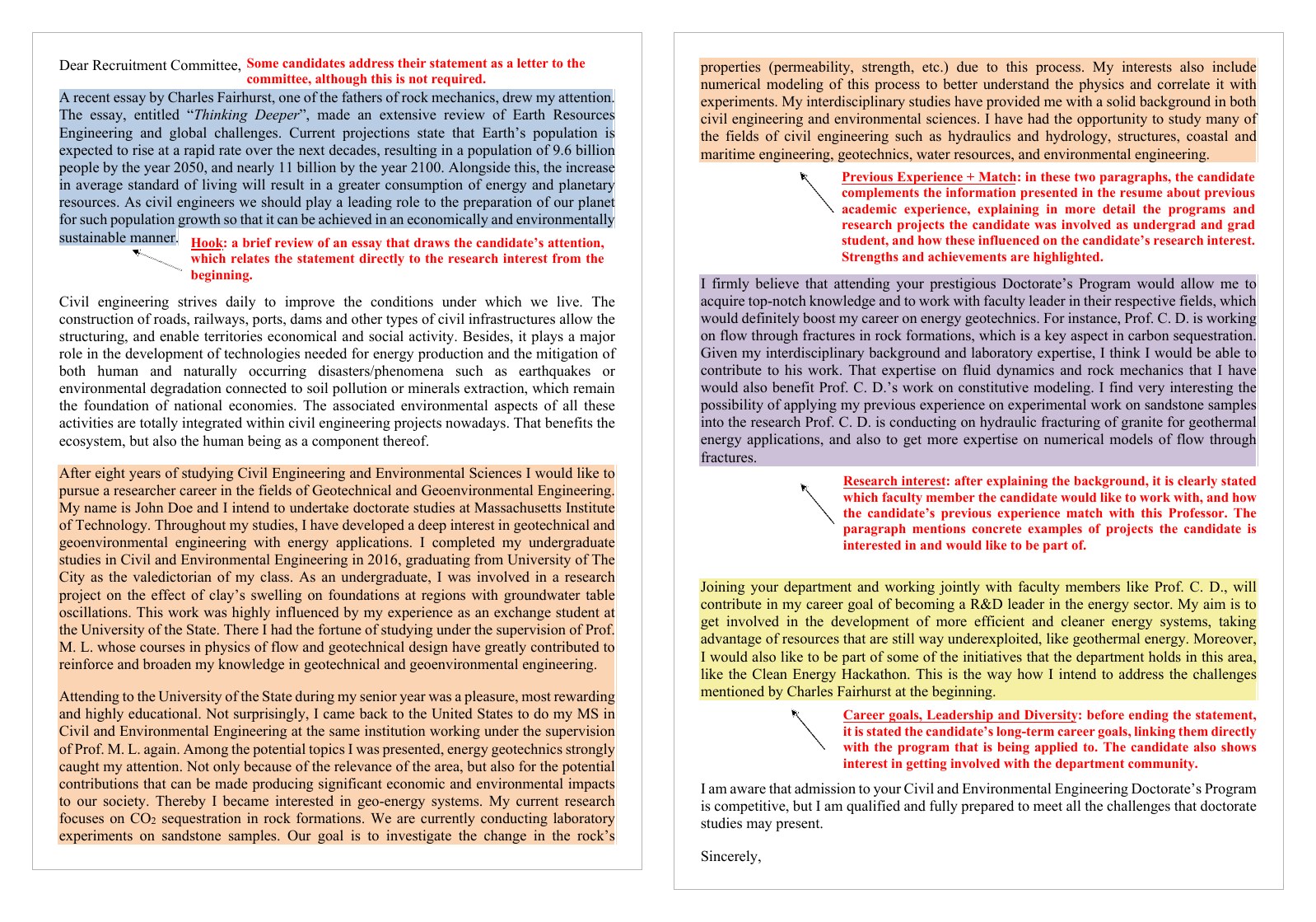
What works
- The hook leads straight to the research interest
- Current project is specific: CO2 sequestration in sandstone
- Names a professor, a project, and how the applicant’s lab skills fit
Annotations by the MIT CEE Communication Lab · CC BY-NC 4.0 · Source: (MIT Civil and Environmental Engineering Communication Lab, n.d.)
Example 2: an admitted statement, annotated
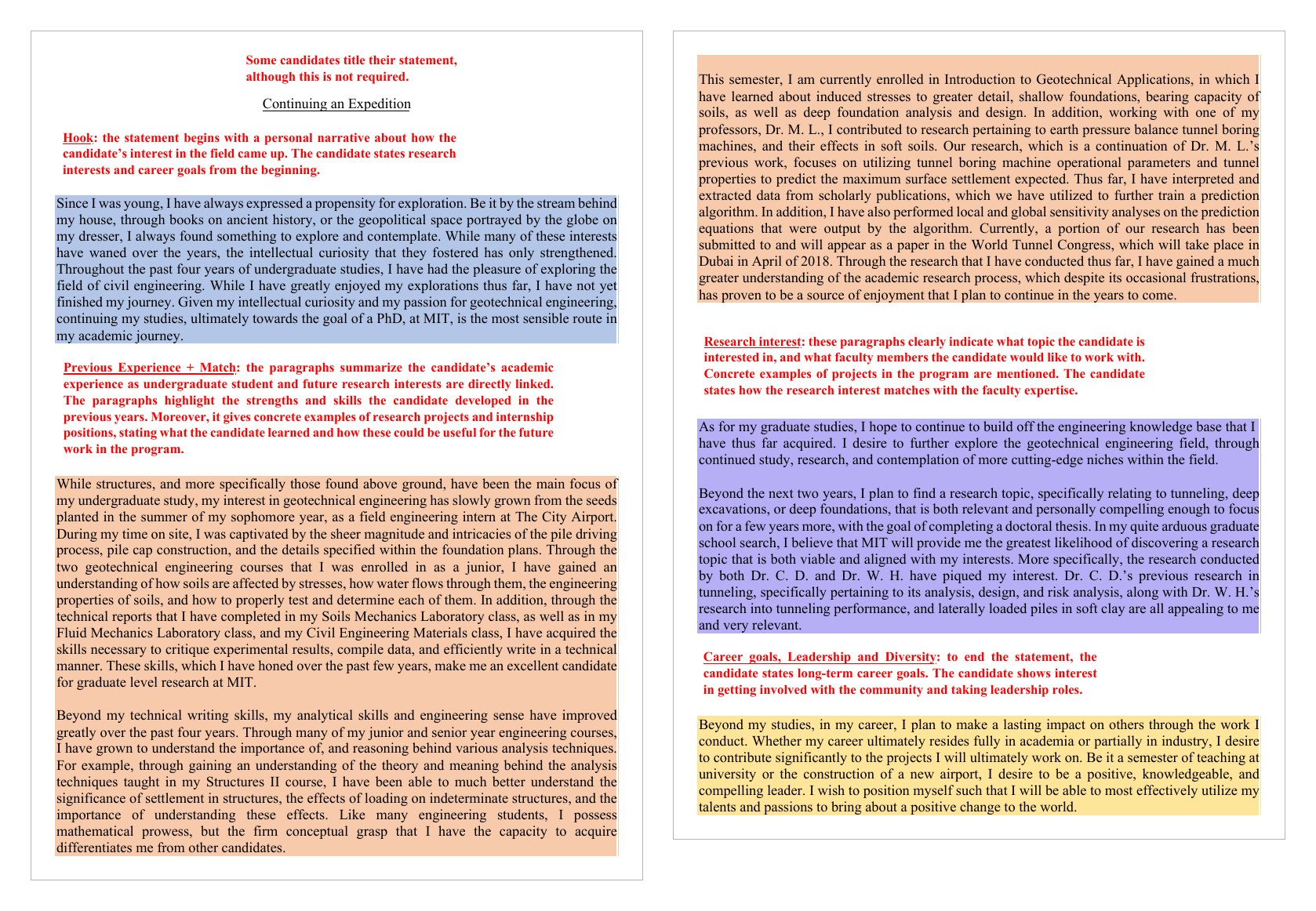
What works
- Undergraduate research in detail: data, a prediction algorithm, sensitivity analyses, a paper submitted
- Names two faculty and the specific topics of each
Annotations by the MIT CEE Communication Lab · CC BY-NC 4.0 · Source: (MIT Civil and Environmental Engineering Communication Lab, n.d.)
The personal statement
When a program asks for one, it wants to know how your background brought you to graduate school, and what you will add.
What goes in
- Formative experiences: education, family, culture, finances
- Challenges and how you responded
- Mentoring, teaching, outreach, leadership
- Context for a record that undersells you
How to write it
- Stories with an outcome: what you did, and what it shows
- End on why graduate school, and why now
- Don’t retell your statement of purpose
It is still a professional document, written for a committee.
Reuse your GRFP work
If you applied to the NSF GRFP, you have already drafted most of this.
| GRFP document | Becomes |
|---|---|
| Graduate Research Plan | The research-interest and “what I’d work on” paragraphs of your statement of purpose |
| Personal, Relevant Background and Future Goals | Your personal statement, and the research-experience paragraphs of your statement of purpose |
| Broader Impacts, in both | Service, outreach, and mentoring in your personal statement |
Adapt, don’t paste. A different prompt, a different reader, and usually a different length.
Your CV for graduate school
Lead with
- Education
- Research experience
- Presentations, posters, publications (mark “submitted” or “in preparation”)
- Skills: instruments, languages, codes
- Awards, teaching, outreach
Compared with your resume
- Research moves to the top
- Length can run past one page
- Confirmed future items are fine, e.g., an accepted conference talk
- Leave off anything that doesn’t help you
Your CV should back up every claim in your statement. More in the resume and CV guide.
Letters of recommendation
Who
- Programs typically ask for three
- Research mentors first; aim for at least two who saw you do research
- A professor from an upper-level course who knows your work
When
- Ask ≥ 4 weeks before your first deadline
- Ask, “Can you write me a strong letter?”
- Remind them a month, two weeks, and one week out
Send everything in one email
- Your CV and a draft statement
- Courses and grades with them
- Programs, deadlines, and submission links
- Reminders of what you did together: projects, results, skills they saw
After
- Tell them where you got in, and thank them
Transcripts, GRE, and English tests
Transcripts
- Upload a transcript when you apply
- Official copies are usually needed only once you are admitted
GRE
- Georgia Tech Physics requires neither the General nor the Physics GRE; check each program
- Physics GRE fall window closes Nov. 1
English tests
- International applicants at Georgia Tech Physics: TOEFL ≥ 106 or IELTS ≥ 7.5
Track every program in one spreadsheet: deadline, fee, statements, letters, and tests.
In-class activity: plan your statement
Fill out the statement of purpose planning worksheet (15 minutes):
- Your research interest, in one sentence
- Your strongest research experience: the question, your role, the result
- One program: 2–3 faculty and the specific work that fits yours
- Your three letter writers, and what each can speak to
Turn it into a one-page draft and bring it to the Oct. 30 workshop.
References
PHYS 4604 · Fall 2026 · Georgia Institute of Technology