Career Paths with a Physics Degree
PHYS 4604 · Lecture 3
Andrew J. Steinmetz
2026-09-11
Upcoming
| What | When | Points |
|---|---|---|
| Resume — PDF to Canvas | Tonight, Sept. 11, 11:59 PM ET | 100 (10%) |
| Fall 2026 All Majors Career Fair | Sept. 14–15 | External participation |
| Online professional presence | Sept. 25 | 4% |
| Research proposal, GRFP style | Oct. 9 | 15% |
The goal of today’s lecture: map out what people actually do with a physics, astrophysics, or applied physics degree, using national data from AIP, APS, and BLS.
Part I: Physics bachelors entering the workforce
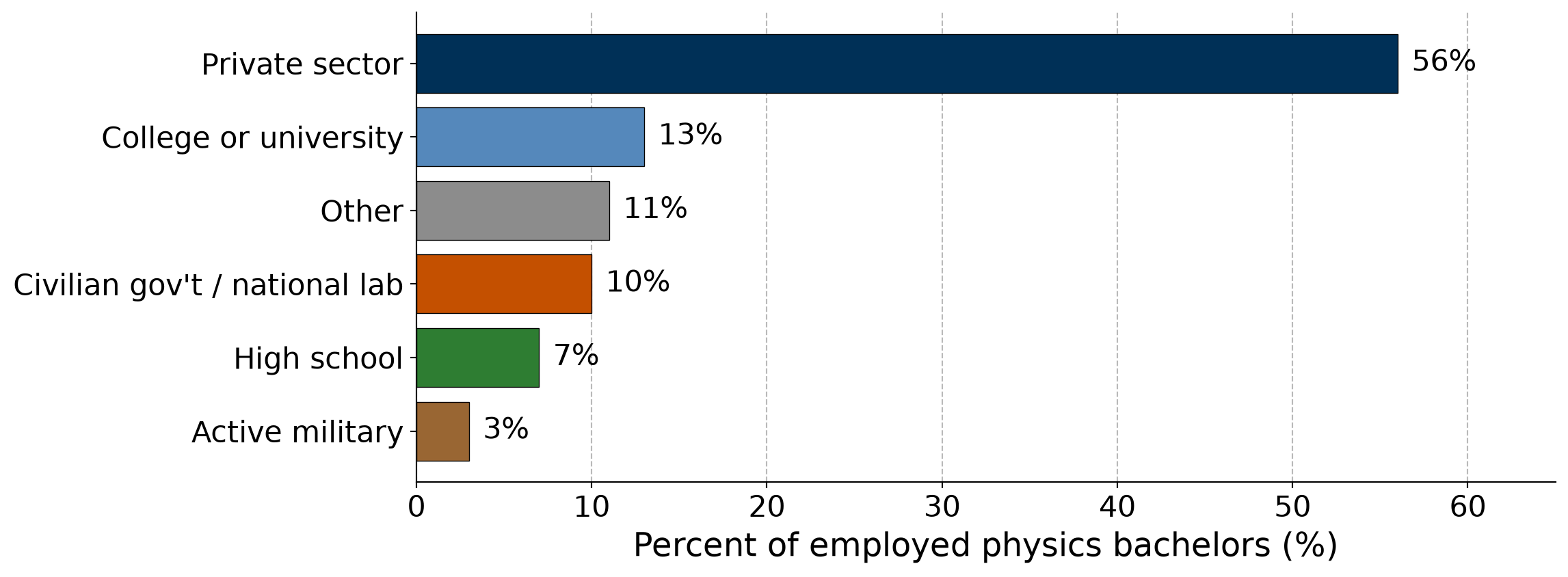
More than half of new physics bachelors who take a job start in the private sector.
Classes of 2022–23 and 2023–24 · (Mulvey and Pold 2026)
What do private-sector physics bachelors do?
| Field of private-sector job | Share |
|---|---|
| Engineering | 38% |
| Computer or information systems | 26% |
| All other fields | 36% |
Nearly two-thirds work in engineering or computing.
Only 3% of employed physics bachelors said they work in physics or astronomy.
Your competition is engineering and CS majors. Sell your problem-solving and modeling toolkit on your resume.
Classes of 2017 and 2018 · (Mulvey and Porter 2021)
Common job titles for new physics bachelors
| Category | Job titles reported by new physics bachelors |
|---|---|
| Engineering | Systems, Electrical, Mechanical, Test, Process, Design, Application Engineer; Engineering Technician |
| Software | Software Engineer/Developer, Data Engineer, Data Analyst, Data Scientist, ML Engineer, Consultant |
| Research | Research Assistant, Research Technician, Patent Examiner, Accelerator Operator, Physicist, Scientist |
| Education | High School Physics/Math Teacher, Middle School Science Teacher, Tutor |
| Business | Data Analyst, Research Analyst, Project Manager, Investment Banker |
As discussed last week, at the career fair (or CareerBuzz), search for these titles, not “physicist.”
Classes of 2021 and 2022 · (American Institute of Physics Statistical Research Center 2024)
Starting salaries for physics bachelors
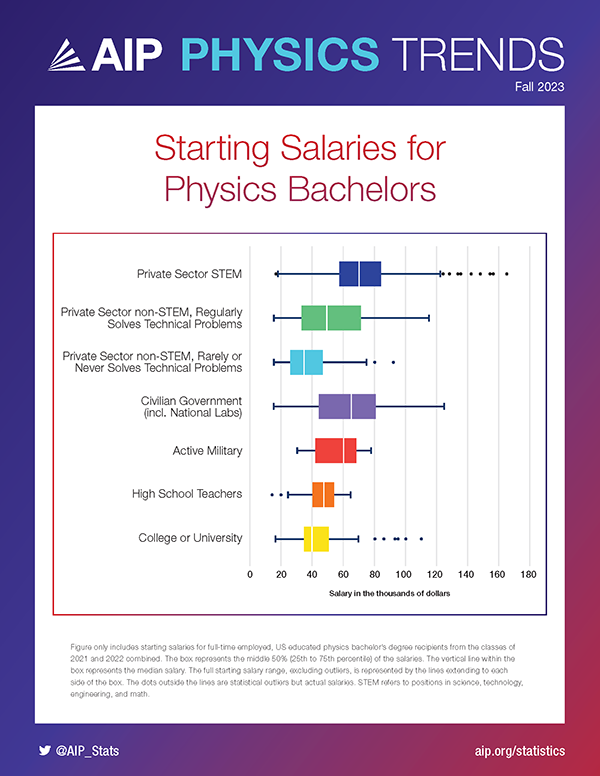
- Private-sector STEM: highest median and widest range
- Civilian government (incl. national labs): next highest
- Non-STEM jobs that regularly solve technical problems pay more than those that don’t
- Teaching and university jobs: lower pay, narrower range
Full-time, U.S.-educated graduates, classes of 2021 and 2022. (American Institute of Physics Statistical Research Center 2023)
Astronomy & astrophysics bachelors
One year after the degree
- 42% were enrolled in graduate school, mostly in astronomy, physics, or astrophysics.
- Among those employed, the private sector was the largest employer (40%).
- Colleges and universities employed about a quarter.
Median starting salary
| Sector | Median |
|---|---|
| Private-sector STEM | $68,500 |
| College or university | $41,600 |
Same pattern as physics bachelors: grad school or industry, with industry paying the most.
Classes of 2021–22 through 2023–24 · (Pold and Mulvey 2026)
Physics vs. Astrophysics vs. Applied Physics
Same core training. Your electives, research, and projects give direction.
| Degree | Natural first-job directions | How to signal it |
|---|---|---|
| Physics | Research & technical, software/data, grad school | Research, computational projects |
| Applied Physics | Engineering (systems, test, optics), national labs | Lab & instrumentation skills |
| Astrophysics | Data science, software, aerospace, grad school | Large-dataset projects, Python |
These are tendencies, not rules. Employers hire on skills and experience, so your resume matters more than the name on your diploma.
Part II: “Physicist” as a job title
| Physicists & astronomers | |
|---|---|
| Median pay (May 2025) | $166,880 |
| Jobs (2025) | 25,600 |
| Projected growth, 2025–35 | 7% |
| Openings per year | ~1,500 |
| Typical entry education | Doctoral degree |
Largest employers of physicists
- Scientific R&D services: 38%
- Federal government: 13%
- Colleges and universities: 10%
Where physics skills get hired
| Occupation | Median pay | Entry education | Growth | Openings/yr1 |
|---|---|---|---|---|
| Software developers | $135,980 | Bachelor’s | 10% | ~106,100 |
| Aerospace engineers | $134,960 | Bachelor’s | 8% | ~3,800 |
| Data scientists | $120,230 | Bachelor’s | 35% | ~24,800 |
| High school teachers | $72,040 | Bachelor’s | 0% | ~63,500 |
| Physicists & astronomers | $166,880 | Doctoral | 7% | ~1,500 |
BLS medians cover all experience levels*; they are not starting salaries.
Median pay as of May 2025; projected growth 2025–35. (U.S. Bureau of Labor Statistics 2026e, 2026a, 2026b, 2026c, 2026d)
Part III: The graduate school path
One year after the degree, new physics PhDs split roughly evenly between postdocs and potentially permanent positions.
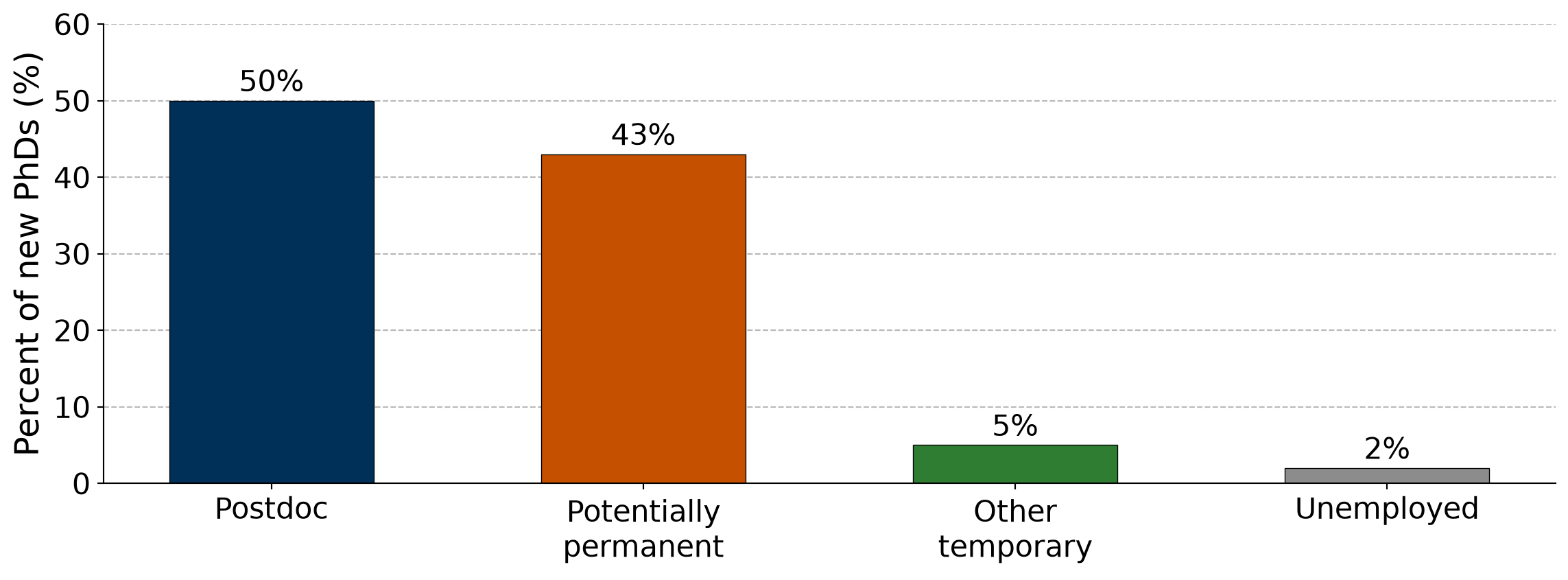
Classes of 2020–21 and 2021–22; U.S.-educated PhDs who remained in the U.S. (n = 1,680) · (Mulvey and Pold 2024)
Where do new physics PhDs work?
| Sector | Postdoc | Potentially permanent |
|---|---|---|
| Academic | 72% | 15% |
| Private | 1% | 73% |
| Government | 24% | 7% |
| Other | 3% | 5% |
63% of potentially permanent positions are in fields outside physics:
- Data science: 21%
- Engineering: 14%
- Computer software: 11%
- Other fields: 17%
Most permanent PhD jobs are in industry, not faculty positions.
Classes of 2020–21 and 2021–22 · (Mulvey and Pold 2024)
Is the PhD “worth it”?
PhDs in potentially permanent positions
| % who felt… | Acad. | Private | Gov’t |
|---|---|---|---|
| PhD is appropriate background | 90 | 86 | 82 |
| Professionally challenging | 73 | 83 | 89 |
| Underemployed | 28 | 17 | 14 |
| Satisfied overall | 73 | 89 | 96 |
Postdocs
- 97% say their skills will be valuable later
- 91% are satisfied
- 56% consider academia their primary goal
Academic prospects?
There’s about 2000/yr new PhDs and about 600/yr faculty positions.
Classes of 2020–21 and 2021–22 · (Mulvey and Pold 2024)
Part IV: How industry careers progress
A physics bachelor usually starts in an entry-level or junior position and advances with experience. At the senior level, the path often splits in two:
Technical track
- Deepen your technical expertise
- Lead the technical work on projects
- Stay close to the science and engineering
Managerial track
- Spend most of your time on project, resource, and personnel management
- High-level management positions are among the highest-paid jobs for physicists in the private sector
Job boards
Physics & Academia
- APS Physics Jobs: academia, labs, and industry
- Physics Today Jobs: physics and related fields
- AcademicJobsOnline: postdoc and faculty positions
- AAS Job Register: astronomy and astrophysics
- INSPIRE Jobs: high-energy physics research positions
Industry & Government
- LinkedIn Jobs: industry and networking
- CareerBuzz: GT jobs and internships
- USAJOBS: federal jobs, including entry-level physicist roles
- Hacker News Jobs: Y Combinator startups
References
American Institute of Physics Statistical Research Center. 2023. Physics Trends: Starting Salaries for Physics Bachelors. American Institute of Physics Statistical Research Center. https://www.aip.org/statistics/starting-salaries-for-physics-bachelors.
American Institute of Physics Statistical Research Center. 2024. Physics Trends: Common Job Titles for New Physics Bachelors. American Institute of Physics Statistical Research Center. https://www.aip.org/statistics/physics-trends-common-job-titles-for-new-physics-bachelors.
American Physical Society. n.d. “Career Profile: Bachelor of Science Jobs in the Private Sector.” Accessed September 11, 2026. https://www.aps.org/careers/advice/bachelor-science-private-sector.
Mulvey, Patrick J., and Anne Marie Porter. 2021. “The Employment Landscape for New Physics Degree Recipients.” Radiations, April. https://students.aip.org/radiations/the-employment-landscape-for-new-physics-degree-recipients.
Mulvey, Patrick, and Jack Pold. 2024. Physics PhDs Initial Employment: Academic Years 2020–21 and 2021–22. American Institute of Physics Statistical Research Center. https://doi.org/10.1063/sr.71bcab7cfc.
Mulvey, Patrick, and Jack Pold. 2026. Initial Employment Sectors of New Physics Bachelors, Academic Years 2022–23 and 2023–24. American Institute of Physics Statistical Research Center. https://www.aip.org/statistics/initial-employment-sectors-of-new-physics-bachelors-academic-years-2022-23-and-2023-24.
Pold, Jack, and Patrick J. Mulvey. 2026. New Astronomy Bachelors: What Comes Next. American Institute of Physics Statistical Research Center. https://doi.org/10.1063/sr.d5de3f91f0.
U.S. Bureau of Labor Statistics. 2026a. “Occupational Outlook Handbook: Aerospace Engineers.” https://www.bls.gov/ooh/architecture-and-engineering/aerospace-engineers.htm.
U.S. Bureau of Labor Statistics. 2026b. “Occupational Outlook Handbook: Data Scientists.” https://www.bls.gov/ooh/math/data-scientists.htm.
U.S. Bureau of Labor Statistics. 2026c. “Occupational Outlook Handbook: High School Teachers.” https://www.bls.gov/ooh/education-training-and-library/high-school-teachers.htm.
U.S. Bureau of Labor Statistics. 2026d. “Occupational Outlook Handbook: Physicists and Astronomers.” https://www.bls.gov/ooh/life-physical-and-social-science/physicists-and-astronomers.htm.
U.S. Bureau of Labor Statistics. 2026e. “Occupational Outlook Handbook: Software Developers, Quality Assurance Analysts, and Testers.” https://www.bls.gov/ooh/computer-and-information-technology/software-developers.htm.
PHYS 4604 · Fall 2026 · Georgia Institute of Technology